- Full biography of the WHO Director-General: Tedros Adhanom Ghebreyesus
- Follow the WHO Director-General: @DrTedros
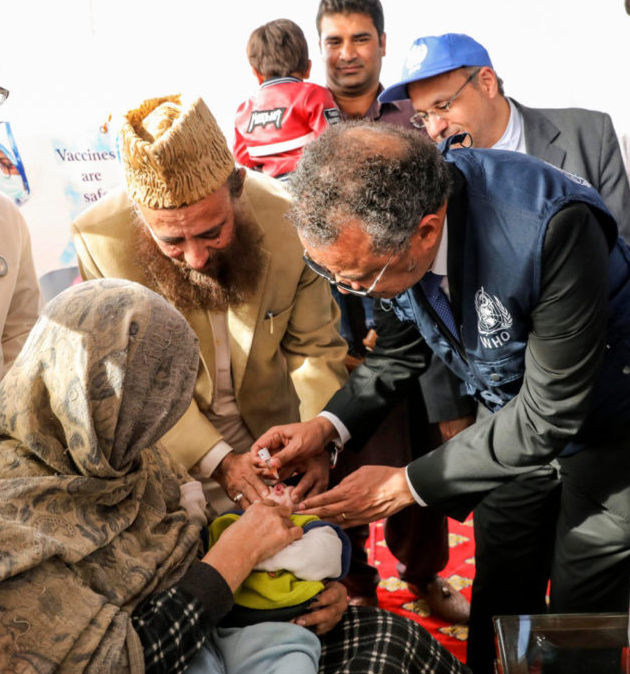
GPEI Q1. The world has reduced polio cases by more than 99%, bringing us closer than ever to eradication. Yet the final step is proving to be the most difficult. Why is this moment so critical?
We are at a truly historic moment. Polio has been reduced from hundreds of thousands of cases each year to a small number of remaining transmission areas. This is one of the greatest public health achievements in history.
But eradication is not gradual – it is absolute. As long as the virus exists anywhere, it remains a threat everywhere.
The final stage is always the hardest because it requires closing the remaining gaps: reaching the most vulnerable children, in the most complex settings, with the vaccines and services they need.
At last month’s World Health Assembly, Member States reaffirmed their commitment to achieving and sustaining a polio-free world. That support is encouraging.
We are closer than ever – but this is exactly the moment when we must not step back. The opportunity is within reach. The responsibility is ours.
GPEI Q2. Polio eradication has brought together governments, communities, civil society and global partners for more than three decades. In a world facing increasing geopolitical tensions, what does this effort tell us about the power of global cooperation?
Like the eradication of smallpox, polio eradication is proof that multilateralism works. For more than three decades, countries, communities, civil society and international organizations have worked together towards a single goal.
At this year’s World Health Assembly, Member States debated many difficult and complex issues. Yet countries from every region and every political perspective remained united behind the goal of eradicating polio.
This is not theoretical cooperation. It is practical, sustained and results driven.
In a time of fragmentation, polio shows us what is possible when we act together. Ending polio will not only be a victory for health — it will be a victory for cooperation. It will show that even in difficult times, the world can come together to solve a common problem and protect future generations.
GPEI Q3. From a scientific perspective, the tools to end polio already exist. So why are we not done — and what are the consequences if global efforts are not sustained?
Unfortunately, that’s true of many global health challenges. In the case of polio, we have safe and effective vaccines, strong surveillance systems and we know how to reach children, even in the most challenging environments.
It’s no accident that polio’s last stronghold is one of the most insecure regions on earth. We face significant barriers in reaching unvaccinated children due in part to community mistrust. In many ways, the issues are similar to those we face in the Ebola outbreak in the Democratic Republic of the Congo (DRC) right now. We know how to prevent infections and save lives, but the outbreak is happening in an area with significant insecurity, displacement and community mistrust. Building and keeping trust is essential to the response.
Like Ebola in the DRC, polio is only one health issue that people in the affected areas of Afghanistan and Pakistan face – and not necessarily the issue that worries them most. It’s therefore essential that we build health systems and services not only for one disease, but for all health needs. Investments in polio are helping to build those systems and services that will serve communities long after polio has been eradicated.
As long as polio is a threat anywhere, it remains a threat everywhere. If we reach every child, we will stop the virus and reap significant economic benefits estimated in the tens of billions. If we do not, polio will return — potentially affecting hundreds of thousands of children in many more countries within a decade, and we will have squandered the huge investments we have made.
This is not a distant risk. It is a very real one.
Eradication is a choice. If we act together, we can ensure that no child anywhere will ever again be paralyzed by polio.